
- Published on
Claude Code ultrathink Explained: One Keyword for 10x Deeper AI Reasoning (2026)
Table of Contents
What is ultrathink? A hidden keyword in Claude Code that triggers high effort deep thinking mode, making the AI spend more tokens on deeper reasoning and analysis.
Applies to: Claude Code v2.1.72+ (March 2026)
How to Use ultrathink (30-Second Version)
Add ultrathink at the start of your prompt:
ultrathink analyze the architectural bottleneck here and propose three refactoring approaches
ultrathink I've been debugging this for two hours with no luck — do a deep analysis of all possible causes
This triggers Claude Code's high effort mode, giving the AI maximum reasoning resources for that turn.
Key point: ultrathink only affects the current turn. After it completes, Claude automatically returns to the default medium effort.
ultrathink Version History (2025 → 2026)
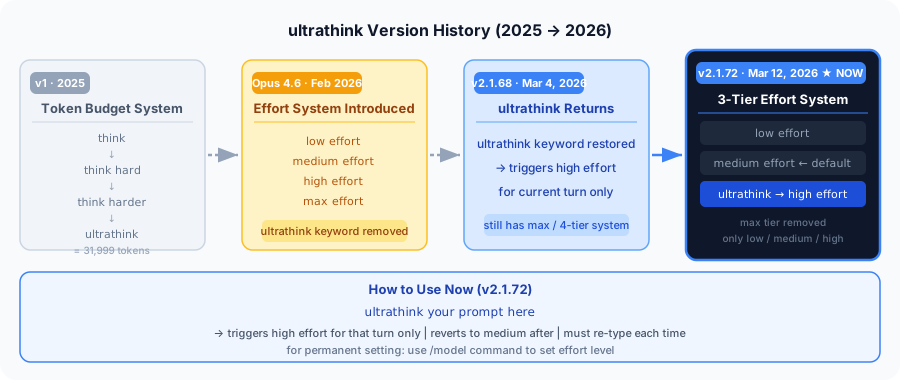
ultrathink briefly disappeared in early 2026, then returned in v2.1.68 with a new implementation. v2.1.72 simplified it to the current three-tier system.
Many older articles still say "ultrathink = 31,999 tokens" — that was the v1 behavior and no longer applies. The current ultrathink triggers an effort level, not a fixed token count.
The 2026 Effort System
| Level | How to Trigger | Best For | Token Cost |
|---|---|---|---|
| low | Set via /model command | Simple queries, Subagent batch tasks | Lowest |
| medium | Default — no action needed | Most everyday development tasks | Medium |
| high | Type ultrathink | Complex architecture, hard-to-trace bugs | Highest |
ultrathink vs Permanent Effort Setting
ultrathink→ high effort for that one turn only, then reverts to medium — best for occasional use/modelcommand → sets effort level for the entire session — better when you need deep thinking throughout a working session
Official Verification
This is not a community-discovered workaround — it's an officially documented Claude Code feature.
From the Claude Code Best Practices official docs:
"We recommend using the word 'think' to trigger extended thinking mode, which gives Claude additional computation time to evaluate alternatives more thoroughly. These specific phrases are mapped directly to increasing levels of thinking budget in the system: 'think' < 'think hard' < 'think harder' < 'ultrathink.'"
This describes the v1 mechanism. In v2, Anthropic switched to the effort system — and officially re-introduced the ultrathink keyword in v2.1.68 as a shortcut to trigger high effort. The underlying implementation changed, but the intent is identical.
When to Use ultrathink
Good Use Cases
- Complex architecture decisions — weighing multiple design approaches with real trade-offs
- Hard-to-trace bugs — when you've tried multiple things and still can't find the root cause
- Deep code analysis — understanding layered or unfamiliar logic
- AI stuck in a loop — Claude keeps repeating the same mistake or can't break out of a pattern
When Not to Use It
- Simple questions or text formatting tasks (default medium is enough)
- Frequent small tasks (using ultrathink every turn will spike your token costs fast)
- Subagent batch tasks (official recommendation is low effort for Subagents to save cost)
FAQ
What's the difference between ultrathink and just saying "think deeply"?
ultrathink is a keyword with a direct system mapping — Claude Code parses it as a high effort trigger. "Think deeply" is natural language that the model interprets semantically, which may or may not produce the same system behavior. In practice, ultrathink is more reliable and consistent.
Do I need to type ultrathink every turn?
Only on turns where you genuinely need deep reasoning. For most everyday tasks, the default medium effort is sufficient. If you need high effort throughout an entire session, use /model to set it permanently instead of typing ultrathink each time.
How many extra tokens does ultrathink use?
There's no fixed number — it depends on the complexity of your task. Compared to medium effort, high effort reasoning typically uses 2–5× more tokens. If you want to track actual usage, pair it with a usage monitoring tool.
References
- Claude Code Best Practices - Anthropic Official
- What is UltraThink in Claude Code - claudelog.com
- Claude Code Release Notes - claudelog.com
- Ultrathink is a Claude Code magic word - Hacker News
Claude Code Best Practices Quick Reference
Beyond ultrathink, here are the most impactful practices for getting better results from Claude Code:
| Practice | What to Do | Why It Works |
|---|---|---|
| CLAUDE.md file | Create a .claude/CLAUDE.md with project context, conventions, and constraints | Claude reads this every session — eliminates repeated explanations |
| Plan before code | Use /plan or plan mode for non-trivial tasks | Prevents Claude from diving into code before understanding the problem |
| Specific prompts | "Refactor the auth middleware to use JWT instead of sessions" vs "fix auth" | Specific prompts get specific results — vague prompts get vague code |
| Iterative turns | Break large tasks into 3-5 focused turns instead of one massive prompt | Keeps context clean and output quality high |
| ultrathink for hard problems | Prefix with ultrathink when stuck on architecture decisions or complex bugs | Triggers high effort mode for deeper reasoning (see above) |
| Git checkpoint workflow | Commit before asking Claude to make large changes | Easy rollback if the output isn't what you wanted |
For more on effort levels and when to use each one, see the effort system section above.
All Claude Code Thinking Words
When Claude Code is processing your request, it displays playful "thinking" verbs as a loading indicator. These are purely cosmetic and don't affect output quality. Here's the complete list of 187 spinner words:
Accomplishing, Actioning, Actualizing, Analyzing, Architecting, Assembling, Brainstorming, Brewing, Bridging, Building, Calculating, Calibrating, Channeling, Charting, Choreographing, Coalescing, Cogitating, Compiling, Composing, Computing, Conceiving, Conceptualizing, Configuring, Conjuring, Connecting, Constructing, Contemplating, Crafting, Creating, Crunching, Crystallizing, Cultivating, Curating, Debugging, Deciphering, Decoding, Deconstructing, Deliberating, Deriving, Designing, Developing, Devising, Diagnosing, Discovering, Distilling, Drafting, Dreaming, Elaborating, Engineering, Envisioning, Evaluating, Evolving, Examining, Experimenting, Exploring, Fabricating, Fashioning, Fine-tuning, Forging, Formulating, Generating, Germinating, Grasping, Hacking, Harmonizing, Hatching, Hypothesizing, Ideating, Illuminating, Imagining, Implementing, Improvising, Incubating, Inferring, Innovating, Inspecting, Integrating, Interpreting, Inventing, Investigating, Iterating, Juggling, Kindling, Knitting, Mapping, Marshaling, Materializing, Meditating, Modeling, Molding, Mulling, Navigating, Nurturing, Optimizing, Orchestrating, Originating, Painting, Parsing, Patterning, Perceiving, Perfecting, Pioneering, Planning, Polishing, Pondering, Preparing, Processing, Producing, Projecting, Prototyping, Puzzling, Questioning, Rationalizing, Reasoning, Recalibrating, Reflecting, Refining, Reformulating, Rendering, Researching, Resolving, Restructuring, Reverse-engineering, Ruminating, Scaffolding, Sculpting, Simulating, Sketching, Solving, Sparking, Speculating, Spinning, Strategizing, Streamlining, Structuring, Studying, Surveying, Symbolizing, Synchronizing, Synthesizing, Tailoring, Tinkering, Tracing, Transforming, Troubleshooting, Tuning, Unifying, Unraveling, Untangling, Upcycling, Validating, Visualizing, Weaving, Wiring, Wondering, Working, Wrestling, Zeroing
These words are randomly selected from a built-in array in the Claude Code CLI. They were first documented by the community and later confirmed in the source code. The words have no connection to the actual thinking process — they're just a fun loading animation.
Support the Author ☕
Support via Ko-fi
Related Posts
Complete tutorial on how to install Claude Code terminal tool on Windows system ...
2025-05-30